A Beginner's Guide to Reading Poetry for Pleasure
Most people who say they don't like poetry had one bad encounter with it: a poem dissected line by line on a worksheet, or a teacher with a correct answer already in mind. That isn't reading. That's an exam. Reading poetry for pleasure works more like hearing a song on the radio — you notice the sound first, the meaning second, and nobody asks you to justify why you liked it.
The other thing to know is that poems are short. You can read a good one in ninety seconds and live with it for a week. That's an enormous advantage over the novel you've been carrying around since spring.
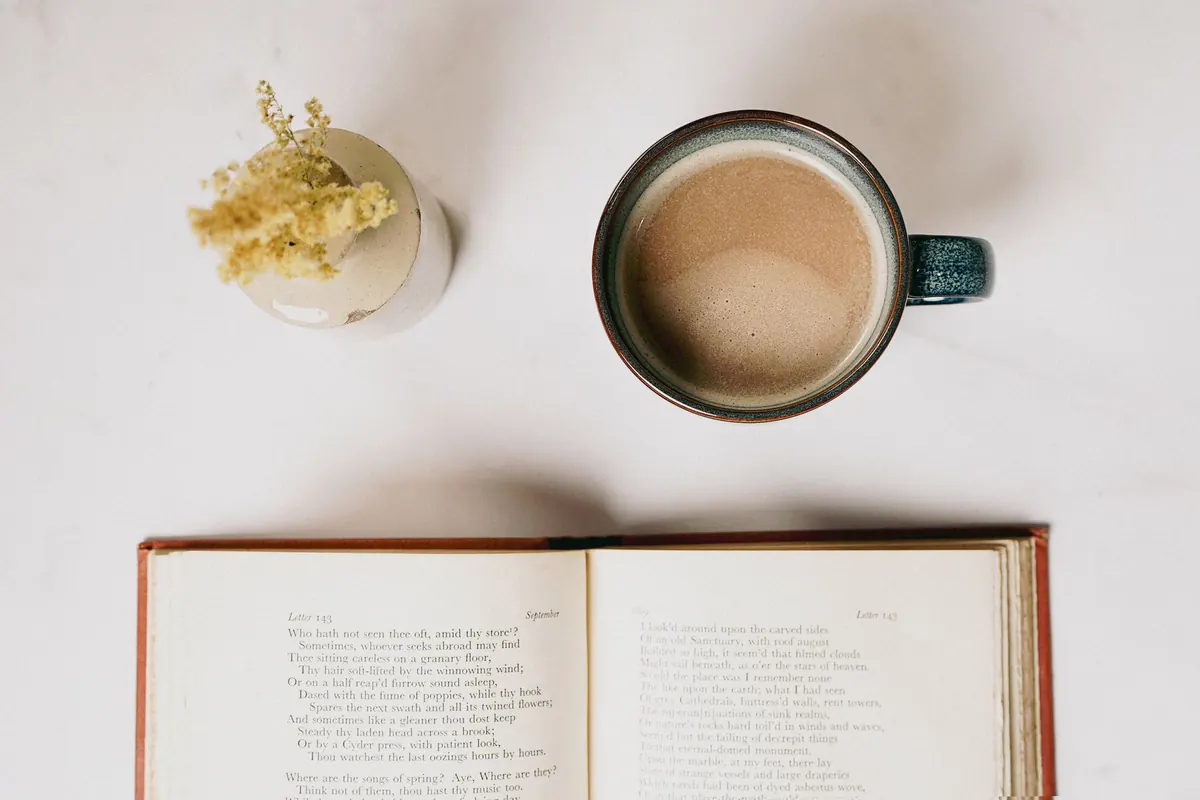
Poems were spoken long before most people could read them, and they still behave best out loud. Read the opening lines aloud, even if your voice feels ridiculous in an empty room. Your mouth catches things your eyes miss: the rhymes, the near-rhymes, the consonants bumping into each other, the places where a line runs out of breath.
The fog comes
on little cat feet.
— Carl Sandburg
You don't need a lecture on that. The short line and the soft consonants do the work. The break after "comes" forces a pause, and the pause is the step. Hearing that for yourself is worth more than any explanation of it.
Pay attention to line endings while you're at it. A line break is timing, not decoration — it's the poet deciding when you breathe. If a line stops mid-sentence, ask why the poem wanted you to hesitate there. Read it once at your normal speaking pace, then once more, slower, and notice which version you prefer. There's no wrong answer.
Before you worry about meaning, ask what the poem is paying attention to. "Season of mists and mellow fruitfulness" opens with weather and ripeness before it offers a single idea. "Something there is that doesn't love a wall" starts with a feeling and one hard fact — a wall — and lets the argument grow from there.
Try this: after one reading, write down the three strongest images you remember. Not the theme, the images. A kitchen chair. Wet slate. The smell of a hospital corridor. If you can still see them tomorrow, the poem has done something real. If the page gave you nothing to see, hear, smell or touch, that's useful information too.
A pencil helps here. Underline concrete nouns and strong verbs. Circle anything that repeats. Repetition is rarely an accident, and a word that shows up three times is usually the poem tapping you on the shoulder.
Poems reward re-reading more than almost any other form, because they're built to be revisited. A simple sequence will carry you through most of them:
You don't have to do this with everything. Save it for poems that intrigue you. For the rest, one reading and out is a perfectly respectable way to live.
Poetry's reputation for difficulty comes from the assumption that a poem is a puzzle with an answer key hidden at the back. It usually isn't. Two careful readers can disagree about a poem and both be right, because the poem isn't a message to be decoded — it's an experience to be had.
So ask better questions than "what does this mean?" Ask: what is this poem paying attention to? Where does it turn? How does it leave me feeling — restless, comforted, irritated? "I don't know what the last line means, but I keep going back to it" is a complete and honest response.
Look things up if you want to. A quick check on a word or a passing reference is fine and often rewarding. But if reading starts to feel like homework, you've taken a wrong turn. Put the poem down. It'll keep.
The fastest way to kill the habit is to decide you must catch up on four centuries of poetry in order. You don't. A handful of books, chosen loosely, will last a year:
Two books and a notebook will carry you a long way. Buy more when you've worn them out, not before.
If you're twenty lines in and your attention has wandered to the dishes, stop reading. Boredom isn't a failure of yours; it's information about the fit between you and that poem, and it's allowed to be a mismatch. Close the book. Nobody is grading you.
Delight deserves the same respect. When a poem lands, copy it out by hand and write the date next to it. Read it again in a year and see whether it still works on you. Over time those copied pages become the most accurate record of your own taste — more reliable than any list of classics.
Keep the whole thing small. Fifteen minutes, four days out of seven, is enough to build the habit. On day one, pick up your anthology and read one poem aloud. On day two, read the same poem twice more. On day three, choose a new one and read only the first stanza — then decide whether to continue. On day four, copy out whichever lines have stayed with you and note what you noticed: a sound, an image, a mood.
Keep the book where you'll see it — on the arm of the sofa, not shelved behind the dictionary. Read in the morning if evenings are noisy. And give yourself permission to abandon freely; a poem you close after eight lines has still cost you nothing.
That's the whole method. Sound first, images second, meaning whenever it arrives. Read aloud, read twice, and trust your own reaction over any reverence for the canon. The pleasure isn't waiting for you at the end of some course of study. It's on the first page, in the first line you happen to say out loud.
Photo: Natalie Goodwin / Pexels
Previous Post
7 Questions to Ask Before Submitting to a Literary Magazine
Next Post
Prose Poetry vs. Flash Fiction: What's the Difference?